
I've recently completed a digital learning project focused on a challenge that is becoming increasingly important for organisations: how do we help people make better decisions with data and AI without expecting everyone to become a data analyst?
The resulting learning experience, Building Confidence with Data, consists of five standalone, scenario-based case studies.
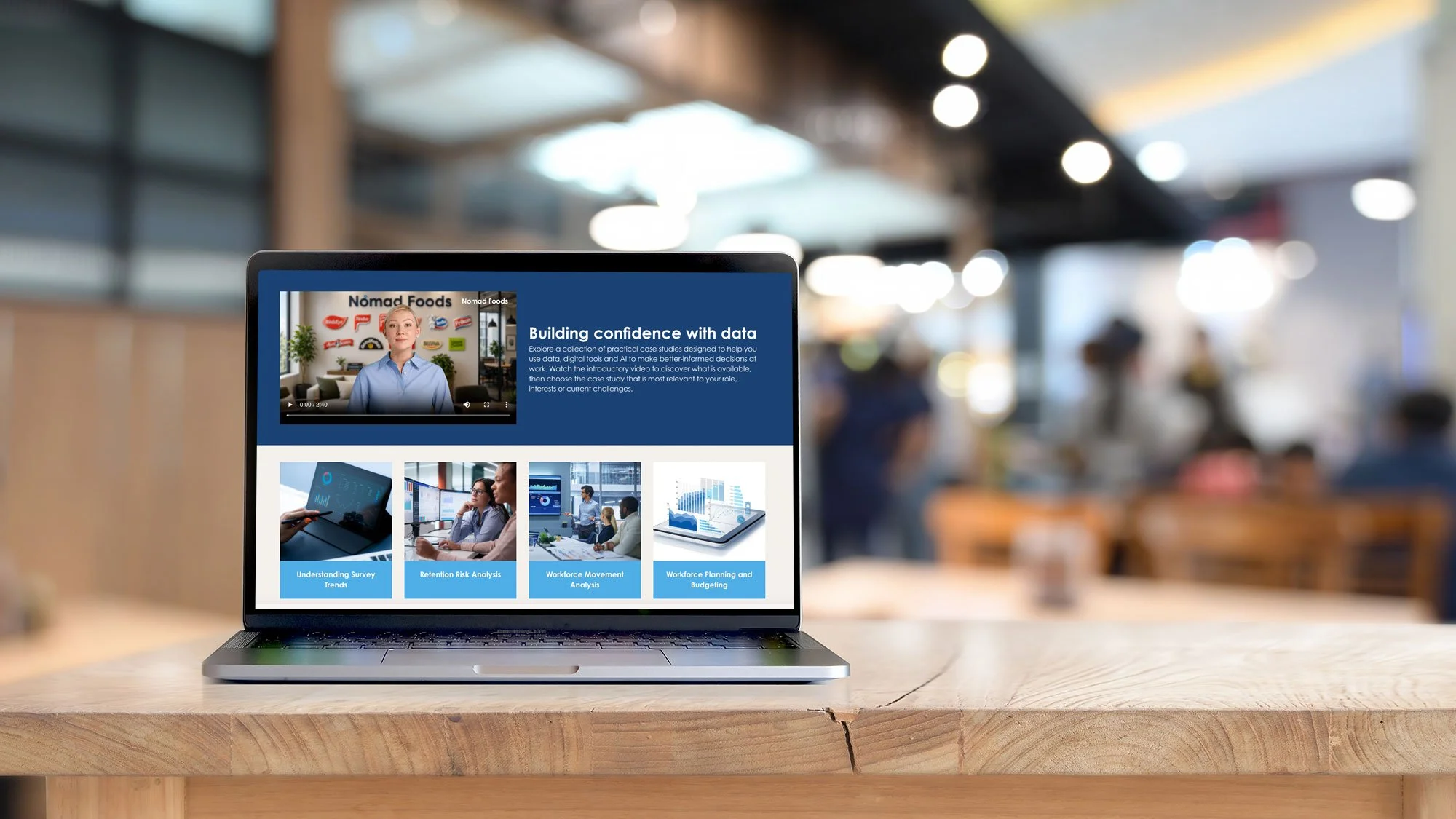
From the outset, the aim was not to teach data analysis as a technical discipline. It was to develop something more widely applicable: the practical judgement people need when data forms part of a workplace decision.
The client brief provided the outline for five realistic workplace scenarios. My role was to develop those initial scenarios into complete digital learning experiences — shaping the learner journey, developing the interactions and decision points, and creating the data, business artefacts and supporting media needed to bring each situation to life.
That led to a very different kind of learning design.
Starting with decisions rather than content
Many data-related courses begin by identifying the concepts learners need to understand and then finding ways to explain them.
For this project, the scenario outlines in the client brief provided the starting point. Each was built around a workplace decision, giving me a strong foundation from which to develop the detailed learning experience.
The five resulting case studies ask learners to investigate changing employee survey results, assess retention risk, uncover patterns in workforce movement, identify what matters within an executive dashboard, and make workforce planning and budgeting decisions when the future is uncertain.
Each scenario provides a reason for looking at the data.
Instead of learning about data and subsequently being asked to apply that knowledge, learners encounter a business problem and have to determine what the available evidence allows them to say about it.
Making the data feel real
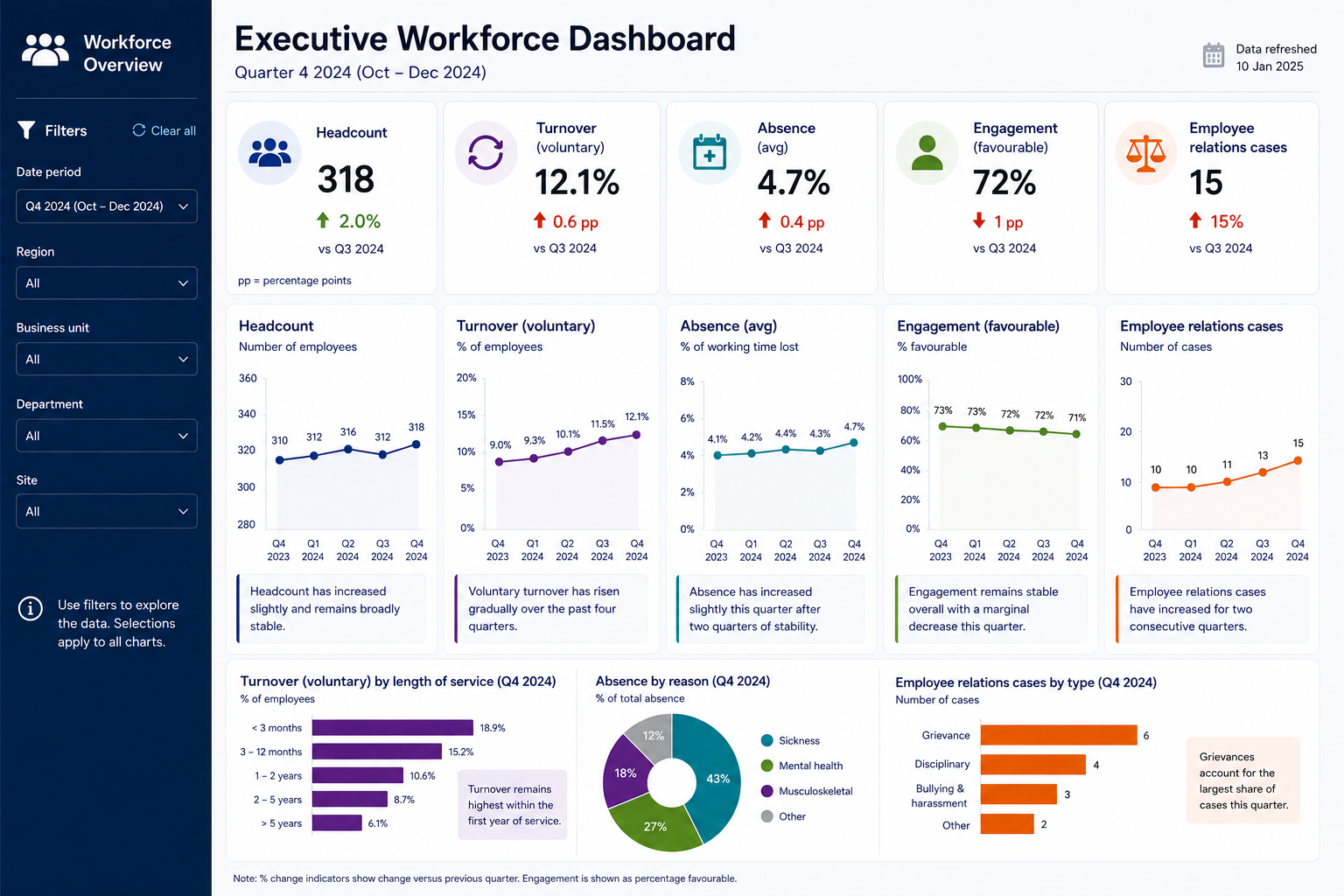
Developing the client-supplied scenario outlines into convincing workplace experiences meant creating the detail around them. An important part of that process was creating realistic business artefacts.
Learners work with spreadsheets, dashboards, survey information, workforce data and communications from fictional colleagues and senior managers.
The data therefore isn't presented simply because the course needs something for the learner to analyse. It exists within the context of a workplace decision.
That creates opportunities to introduce some important questions:
What is the headline figure hiding?
Is this actually a meaningful pattern?
What happens when the data is segmented differently?
What assumptions are we making?
What doesn't the available evidence tell us?
These questions are often more valuable than simply being able to calculate another metric.
Using AI without outsourcing judgement
AI also plays a deliberate role in the scenarios.
I wanted to avoid two extremes: treating AI as a magic answer generator, or adding a generic section about responsible AI that sits separately from the rest of the learning.
Instead, I integrated AI into the learning activities where its use made sense within the scenarios, so that it appears where someone might realistically use it.
It can help summarise information, identify possible patterns and produce a useful first pass at an analysis.
But that creates another decision for the learner.
Is the AI interpretation actually supported by the data?
In one scenario, for example, AI can accurately describe several patterns in an executive dashboard. The problem isn't that its analysis is wrong. The problem is that it doesn't know which of those observations matters most for the senior audience receiving the briefing.
That distinction is important.
AI can accelerate analysis. Human judgement is still required to understand context, weigh priorities and decide what action is justified.
Designing for uncertainty
One of the most interesting challenges came in the workforce planning and budgeting case study.
The scenario outline presented the learner with a business growth forecast and the need to recommend a workforce approach. In developing the learning experience around that brief, I wanted to preserve an important feature of the scenario: there isn't a single obviously correct answer. Each option involves a different balance between cost, capacity and risk.
Later, new information emerges: an automation programme will affect future labour demand.
The learner then has to reconsider the original recommendation.
The important design decision was not to turn this into a conventional right-or-wrong reveal.
The original recommendation was made using the evidence available at the time. The learning comes from deciding whether the new evidence is significant enough to justify changing it.
That reflects an important aspect of real decision-making.
Changing a recommendation when circumstances change isn't necessarily evidence that the original decision was poor. It can be evidence of good judgement.
A consistent framework without a prescribed journey
Although the five case studies can be completed independently, they share a common approach:
Read → Explore → Verify → Prioritise → Decide → Communicate → Adapt
That framework provides some structure without turning decision-making into a rigid process.
It also reflects something I wanted to reinforce throughout the project: good decisions rarely come from a single number, dashboard or AI-generated response.
They come from combining evidence with context and judgement.
Building confidence through practise
The finished experience combines Articulate Rise with custom-designed spreadsheets, dashboards, interactive activities, video, workplace communications and downloadable resources.
But the technology isn't really the interesting part.
What matters is what the learner is being asked to do with it.
Working from the workplace scenarios provided in the original brief, I developed learning experiences in which learners investigate, interpret, compare, question, prioritise and make decisions rather than repeatedly consuming information and answering questions about what they've just read.
For me, that's where scenario-based digital learning becomes particularly powerful.
If we want people to become more confident making decisions with data and AI, we need to give them opportunities to practise making those decisions — including situations where the evidence is incomplete, where different interpretations are possible and where circumstances change.
Because ultimately, better use of data isn't just about having more information.
It's about developing the judgement to decide what that information means and what to do next.

Written and published by
Steve Hogg